
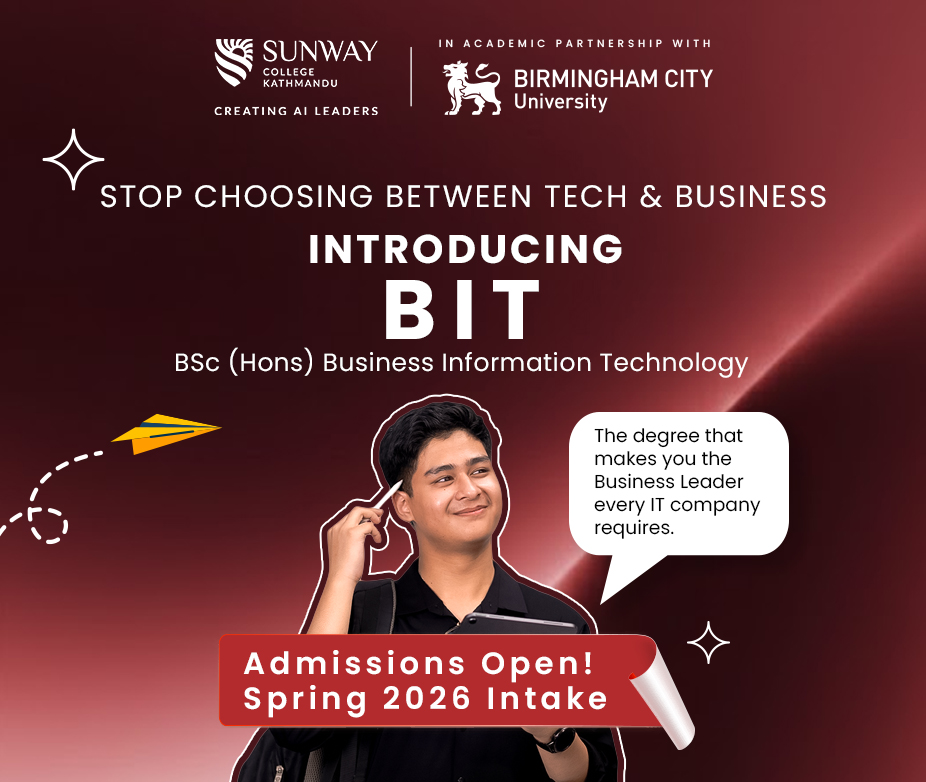
BSc (Hons) Business Information Technology
Admissions Open

-
Admission Eligibility
- Students must complete the grade 12 exam conducted by the National Exam Board (NEB) or equivalent with an aggregate score ≥ 2.6 CGPA
- For A-Levels, a minimum of 3.0 credits with at least a grade of D and above (112 UCAS points or above)
- Applicants must demonstrate their English proficiency with a minimum of Grade B or above in English at Grade 12 and BCU EPT Listening and Speaking Test (each band 5.5) OR BCU-recognized English Tests: IELTS/TOEFL/PTE/ELLTS –6.0 overall with 5.5 minimum in all bands
Overview
The Business Information Technology (BIT) course is purposefully designed to develop students into highly skilled professionals who can bridge the often-significant gap between business needs and technical solutions within organisations and projects. In an era where digital transformation is pivotal for growth and competitiveness, this course equips students with the critical skills and practical experience necessary to communicate and collaborate seamlessly with business users, regardless of whether they operate in technical or non-technical industries. The course offers a strong foundation in computing and information systems, combined with a specialised focus on business analysis and entrepreneurship; the BIT course prepares graduates to navigate the modern business landscape. The course is ideal for students looking to play key roles in aligning business strategies with cutting-edge technology solutions, ensuring companies remain competitive and innovative in today’s fast-evolving digital economy.
The BIT curriculum offers students deep knowledge in key areas essential for modern businesses:
· Solution Development: Students will gain expertise in traditional software development and emerging low-code platforms, allowing them to deliver scalable and adaptable business solutions.
· Business Analysis Tools and Techniques: Students will be knowledgeable about tools and methodologies for analysing business processes, identifying inefficiencies, and proposing innovative technical solutions that align with organisational goals.
· Business and Entrepreneurship: Students will develop an understanding of the core principles of business operations, entrepreneurship, and how to use technology to drive growth, providing a unique skill set that blends technical prowess with business acumen.
· The course curriculum is heavily vocational and designed to equip students with hands-on experience and real-world skills directly applicable in professional settings. While practical learning is at the core, it is underpinned by critical concepts and theoretical knowledge, ensuring a solid academic foundation.
· The BIT course uses industry-standard tools and technologies to ensure students gain exposure to the systems and platforms they will likely encounter in the workplace. These include Microsoft Office 365 (PowerApps, Power Flow, Microsoft Dynamics, Power BI).
· The course also offers opportunities for students to pursue industry-recognized certifications. These certifications enhance students’ employability and ensure they are job-ready upon graduation.
Modules
Semester 1
Business Information System
Computational Thinking and Professional Development
Computer Systems
Semester 2
Business Information Modelling
Introduction to Programming
Innovation Project
Semester 1
Database System Development
Business Process Reengineering
Enterprise System
Semester 2
Human-Computer Interaction
Applied Programming
Enterprise Practice Project
Sesmester 1
Strategic Information Systems Alignment
Business Intelligence
Individual Project
Semester 2
Consultancy and IT Management
Application Solutions Development
Individual Project
Job Roles After you Graduate
- Business Analysts: Professionals who assess business needs, identify technological solutions, and facilitate stakeholder communication.
- Consultants: Experts who advise organisations on leveraging technology to achieve business goals and improve operational efficiency.
- IT Product Owners: Individuals who oversee the development and delivery of technology products, ensuring they meet the business's and its users' needs.
- Solution Developers: Developers design, build, and implement technology solutions aligning with organisational objectives.